
Norton’s theorem
it is a fundamental concept in electrical circuit analysis that allows for the simplification of complex linear circuits.
Key points about Norton’s theorem include:
Equivalent circuit:
It states that any linear circuit with two terminals can be replaced by an equivalent circuit consisting of a current source in parallel with a resistor.
Norton current:
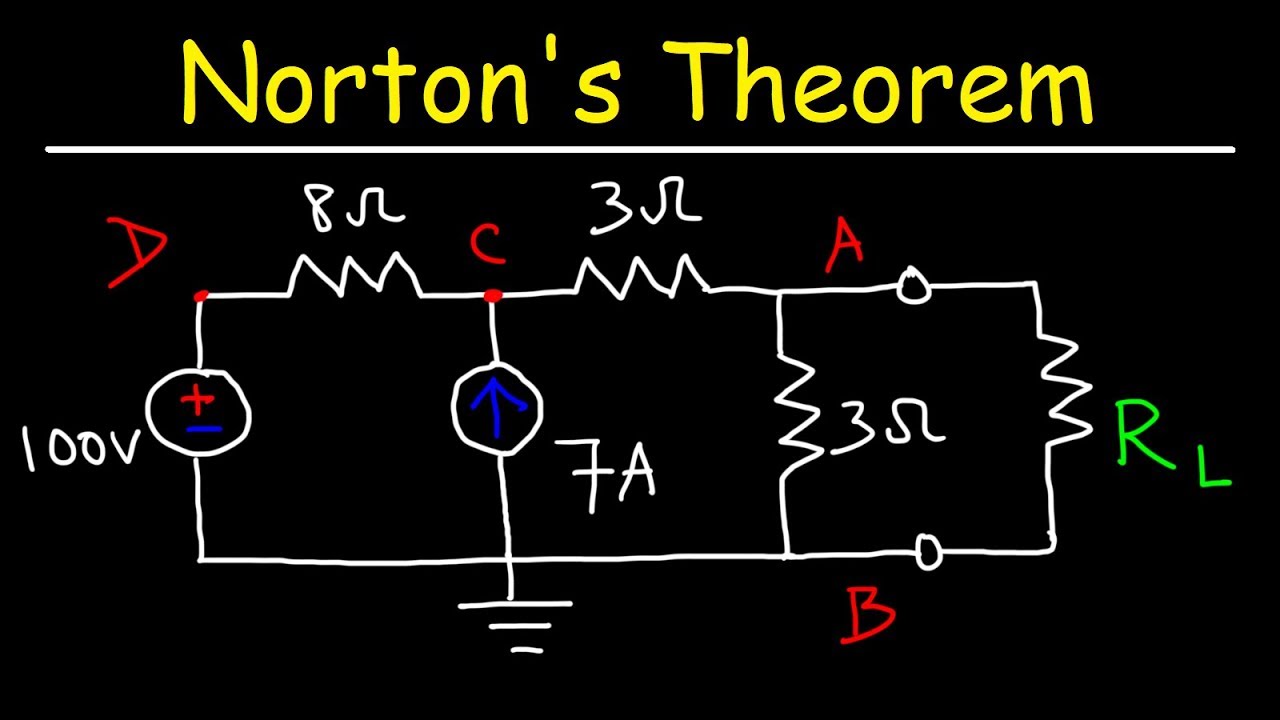
The current source in the equivalent circuit represents the short-circuit current between the two terminals of the original circuit.
Norton resistance:
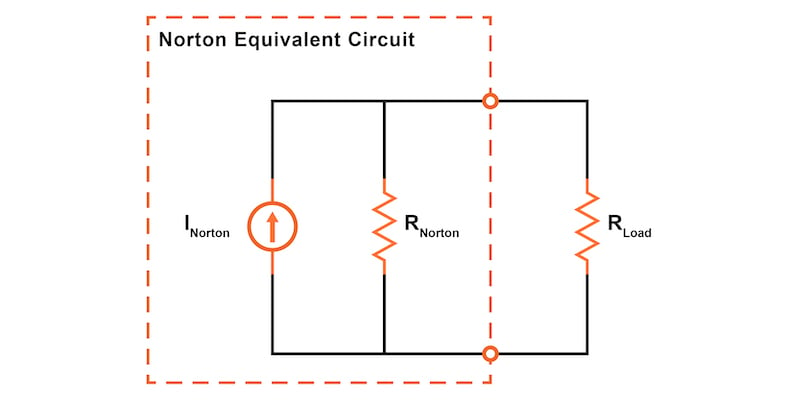
The parallel resistor is equivalent to the resistance seen between the two terminals when all independent sources in the original circuit are deactivated.
Calculation process:
a. Short-circuit the load terminals
b. Calculate the short-circuit current
c. Remove the load and deactivate all independent sources
d. Calculate the equivalent resistance between the terminals
Relationship to Thévenin’s theorem:
Norton’s theorem is the dual of Thévenin’s theorem, which uses a voltage source in series with a resistor.
Applications:
Used in circuit analysis, power systems, and electronic design to simplify complex networks and analyze load variations.
Limitations:
Applies only to linear circuits and is most useful for single-port networks. Understanding and applying Norton’s theorem can significantly simplify circuit analysis and design tasks in electrical engineering.
FAQS:
What is Norton’s Theorem?
Norton’s Theorem states that any linear, bilateral electrical network can be replaced by an equivalent circuit consisting of a single current source (called the Norton current) connected in parallel with an equivalent resistance (called the Norton resistance).
What is Norton current?
Norton current (INI_NIN) is the current that flows through the output terminals when they are short-circuited. It is also known as the short-circuit current of the network and serves as the current source in the Norton equivalent circuit.
How do you calculate Norton resistance?
Norton resistance (RNR_NRN) is calculated by deactivating all independent sources in the circuit and measuring the equivalent resistance seen from the output terminals. Specifically:
- Replace independent voltage sources with short circuits.
- Replace independent current sources with open circuits.
- Calculate the equivalent resistance across the output terminals.
Alternatively, if the Thevenin resistance (RThR_{Th}RTh) is already known, then:
RN=RThR_N = R_{Th}RN=RTh
What is the difference between Norton and Thevenin?
The main difference is the type of equivalent source used:
- Norton’s Theorem represents the circuit as a current source in parallel with a resistance.
- Thevenin’s Theorem represents the circuit as a voltage source in series with a resistance.
Both theorems produce electrically equivalent circuits, and the equivalent resistances are equal (RN=RThR_N = R_{Th}RN=RTh). The choice between them depends on which form is more convenient for circuit analysis.
Where is Norton’s Theorem used?
Norton’s Theorem is widely used in electrical and electronics engineering to simplify complex linear circuits. Common applications include:
- Analyzing DC and AC electrical networks.
- Simplifying circuits with multiple sources.
- Calculating load current and voltage.
- Designing and testing electronic circuits.
- Solving electrical engineering problems in academic and industrial settings. reading further for guass’s law.